Updated Autodesk RVT_ELEC_01101 Demo | Valid RVT_ELEC_01101 Test Online
Wiki Article
What's more, part of that Real4dumps RVT_ELEC_01101 dumps now are free: https://drive.google.com/open?id=1VbkiXhyHWi-BSBOK3PHD41vya5i2rt2L
The pass rate is 98.65%, and we can ensure you copyright if you choose RVT_ELEC_01101 training materials from us. In addition, we have professional experts to compile and verify RVT_ELEC_01101 questions and answers, therefore you can just use them at ease. We also pass guarantee and money back guarantee if you fail to copyright. Free update for RVT_ELEC_01101 Training Materials is available, namely, in the following year, you don’t need to spend a cent, but you can get the latest information of the exam. And the latest version for RVT_ELEC_01101 exam briandumps will send to your email automatically.
Autodesk RVT_ELEC_01101 Exam Syllabus Topics:
| Topic | Details |
|---|---|
| Topic 1 |
|
| Topic 2 |
|
| Topic 3 |
|
| Topic 4 |
|
| Topic 5 |
|
>> Updated Autodesk RVT_ELEC_01101 Demo <<
Valid Autodesk RVT_ELEC_01101 Test Online & RVT_ELEC_01101 Valid Test Online
Rely on Real4dumps’s easy RVT_ELEC_01101 Questions Answers that can give you first time success with 100% money back guarantee! Thousands of professional have already been benefited with the marvelous RVT_ELEC_01101 and have obtained their dream certification. There is no complication involved; the exam questions and answers are simple and rewarding for every candidate. Real4dumps’s experts have employed their best efforts in creating the questions and answers; hence they are packed with the relevant and the most updated information you are looking for.
Autodesk Certified Professional in Revit for Electrical Design Sample Questions (Q49-Q54):
NEW QUESTION # 49
Refer to exhibits.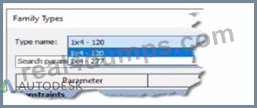
(The image Is presented in Imperial units: 1 In = 25 mm (Metric units rounded].) An electrical designer creates a lighting fixture family with the following types and then saves the family.
- A. 0
- B. 1
- C. 2
- D. 3
Answer: C
Explanation:
In Autodesk Revit, each type within a family represents a unique combination of parameters such as size, voltage, photometric properties, and construction configuration. When a family is created in the Family Editor, the designer can define multiple Family Types using the Family Types dialog. This interface allows the user to duplicate, rename, or modify type parameters before loading the family into a project.
In the exhibit, the Type Name dropdown list clearly shows two available lighting fixture types:
1x4 - 120
1x4 - 277
These two types appear to represent different voltage configurations of the same 1x4 light fixture format. Since these are the only types visible in the Family Types selection preview, the correct number of family types saved within the family file is two.
Revit's behavior aligns with standard family management described in documentation, which explains that every defined type is listed in the Family Types browser. When a designer saves a family, all defined types are stored and become available for placement in the project environment. Devices can then be selected based on parameters such as voltage or photometric values, which are often driven by electrical design requirements.
The Revit MEP User's Guide explains how type properties and family types are controlled:
"Selection of named items or elements [such as Family Types] are managed through the Properties and Family Types dialogs, allowing multiple variations to exist within a single family."
NEW QUESTION # 50
Refer to exhibit.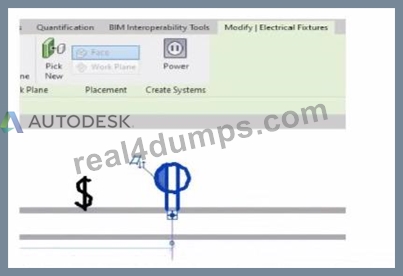
An electrical designer is circuiting a dwelling unit. The receptacle (electrical fixture) shown must be controlled by the switch (lighting device) shown to switch a plug-in lamp When the receptacle is selected, Revit does not provide an option to add the receptacle to a switch system.
What is causing this issue?
- A. A switch system has not yet been created.
- B. Only lighting fixtures can be added to switch systems.
- C. The switch and the receptacle are not on the same circuit
- D. The receptacle's "Switchable" option Is not selected within the family editor.
Answer: D
Explanation:
In Autodesk Revit Electrical Design, when an electrical designer attempts to control a receptacle (an Electrical Fixture family) with a switch (a Lighting Device family) as part of a switch system, Revit will only allow this connection if the receptacle's family has been configured as Switchable within the Family Editor.
According to the Autodesk Revit MEP User's Guide (Chapter 17 - "Electrical Systems"):
"Revit allows you to add elements such as lighting fixtures or receptacles to a switch system only if the family includes a switchable connector. The 'Switchable' parameter must be enabled in the Family Editor to allow this connection." This means that for the receptacle shown in the exhibit to appear as an available component for switching, the Electrical Connector within its family must have the Switchable property checked. This parameter is found under:
Family Editor → Select Connector → Properties Palette → Electrical - Data → Switchable.
If this option is not enabled, Revit treats the receptacle as a standard unswitched outlet and will not display it in the switch system creation dialog. Once the option is checked, the designer can reload the family into the project and associate it with a switch system normally.
Additionally, the Smithsonian Facilities Revit Template User's Guide explains this concept as follows:
"To associate receptacles with lighting switches, ensure that the receptacle family has a switchable connector. Without this setting, the device will not appear as an assignable component to a switch system." This distinction is important in residential electrical modeling, where switched receptacles are common for plug-in lamps. Lighting circuits can include both Lighting Fixtures and Switchable Receptacles when the family configuration supports it.
Incorrect Options Explanation:
A . A switch system not being created is irrelevant - the issue occurs before system creation.
C . Being on the same circuit doesn't affect switchability; it affects electrical load connection.
D . Incorrect - Revit supports switchable receptacles if properly configured.
Therefore, the correct answer is B. The receptacle's "Switchable" option is not selected within the family editor.
References:
Autodesk Revit MEP User's Guide - Chapter 17 "Electrical Systems," pp. 417-421 Autodesk Revit Electrical Design Essentials - Section "Creating and Editing Electrical Fixtures and Switch Systems" Smithsonian Facilities Revit Template User's Guide - Section 8.4 "Switchable Receptacle Family Standards," p. 89
NEW QUESTION # 51
Exhibit.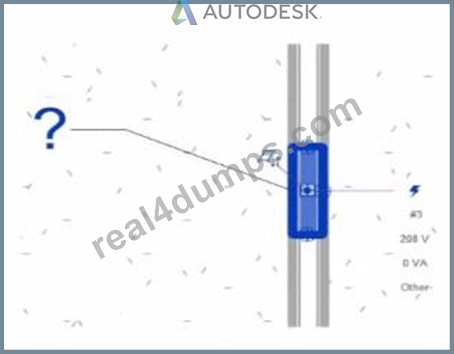
An electrical designer creates a panel schedule. Which Electrical Equipment parameter defines the default name of the panel schedule view?
- A. Type Mark
- B. Description
- C. Mark
- D. Panel Name
Answer: D
Explanation:
In Autodesk Revit for Electrical Design, when a designer creates a panel schedule, the default name of the panel schedule view is automatically derived from the Panel Name parameter of the Electrical Equipment family to which the circuits are assigned.
According to the Revit MEP User's Guide (Electrical Systems section: Panel Schedules):
"When you create a panel schedule, Revit uses the Panel Name parameter of the electrical equipment to define the default schedule name. The Panel Name identifies the distribution panel that supplies the circuits. This name appears in both the Panel Schedule view and in circuit information tags."
- Revit MEP User's Guide, Chapter 17: Electrical Systems - Panel Schedules The Panel Name is a critical electrical equipment instance parameter located in the Electrical - Circuiting group of properties.
It appears in both the Electrical Equipment Properties Palette and the Panel Schedule Header. This name can later be modified manually, but by default, it directly controls the naming convention of the generated schedule.
In contrast:
A . Type Mark - identifies types within the family for documentation and does not control schedule naming.
B . Mark - a unique instance identifier often used for tags, but not for panel schedule view naming.
C . Description - provides descriptive text only for documentation or labeling.
D . Panel Name - correctly defines and drives the default schedule view name for panels and circuits.
When a panel (electrical equipment) is placed in the model and circuits are connected, Revit generates a new Panel Schedule View automatically titled using the value entered in the Panel Name field (e.g., "Panel LP-1"). This ensures consistency between the modeled equipment and the schedule documentation.
Verified Reference Extracts from Revit for Electrical Design Documentation:
Autodesk Revit MEP User's Guide (2011), Chapter 17: Electrical Systems - Creating and Editing Panel Schedules:
"The name of the panel schedule view is determined by the Panel Name property of the electrical equipment." Revit MEP Electrical Design Training Manual, Module: Electrical Equipment and Panel Schedules:
"Panel Name is used by Revit as the default identifier for any panel schedule view created for that equipment."
NEW QUESTION # 52
Refer to exhibit.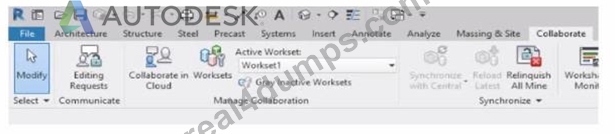
Why is Synchronize with Central disabled?
After enabling collaboration for a project, an electrical designer observes the ribbon.
- A. The central model is unavailable or not found.
- B. The designer has unresolved editing requests.
- C. The designer has unrelinquished elements.
- D. The designer is working in the central model.
Answer: D
Explanation:
In Autodesk Revit, the Collaborate tab provides the tools necessary for managing multi-user worksharing environments. The Synchronize with Central command allows users to save their local changes back to the central model. However, this command becomes disabled under certain conditions - most notably when the user is currently working directly within the central file rather than a local copy.
The Autodesk Revit User's Guide - Worksharing and Collaboration section clearly explains this behavior:
"When you open the central file directly, the Synchronize with Central option is unavailable because all edits are already in the central file. Worksharing operations such as borrowing, relinquishing, or synchronization only apply to local copies created from the central model." This rule ensures that the integrity of the central model is preserved and that no user directly edits or synchronizes within it, preventing potential file corruption. In normal collaborative workflows, users open local copies of the central model. The local files maintain an editable subset of elements while allowing synchronization and relinquishing operations.
Thus, the disabled Synchronize with Central button (as shown in the exhibit) indicates that the designer is currently in the central model, not a local copy. Since synchronization is unnecessary in this state - all changes are automatically applied to the central file - the command is grayed out.
NEW QUESTION # 53
An electrical designer has noticed lighting fixtures present in an architectural linked model. Which tool should be used to place an instance of those fixtures in the current electrical model while maintaining the position from the architectural model?
- A. Copy/Monitor
- B. Reload Latest
- C. Reconcile Hosting
- D. Coordination Review
Answer: A
Explanation:
When lighting fixtures placed in an architectural linked model need to be replicated in the electrical model while maintaining their exact positions, the correct tool is Copy/Monitor.
This Revit feature allows the electrical designer to copy elements-like lighting fixtures-from a linked model into their project, while establishing a monitoring relationship between the original (architectural) and copied (electrical) instances.
From the Autodesk Revit MEP User's Guide - Chapter 55 "Multi-Discipline Coordination" (pages 1349-1357):
"Use the Copy/Monitor tool to copy MEP fixtures from an architectural model into an MEP project, and monitor them for changes." (Revit MEP User's Guide, p. 1350)
"To copy fixtures from a linked model:
Click Collaborate tab ➤ Coordinate panel ➤ Copy/Monitor ➤ Select Link.
Select the linked architectural model in the drawing area.
Click Copy and select the lighting fixtures to copy.
Click Finish.
Revit MEP copies the fixtures to the current project and establishes monitoring relationships."* (Revit MEP User's Guide, p. 1356) Behavior and Benefits:
The copied lighting fixtures maintain the same location, orientation, and type mapping as in the linked model.
Any changes (move, delete, or modify) made by the architect in the linked model will trigger a coordination review in the electrical model.
This ensures accurate positioning and easy coordination between disciplines.
"When you select a copied fixture in the current project, the monitor icon displays next to the fixture, indicating that it has a relationship with the original fixture in the linked model." (Revit MEP User's Guide, p. 1357)
"If copied fixtures are moved, changed, or deleted in the linked model, Revit MEP notifies the engineers of the changes during Coordination Review." (Revit MEP User's Guide, p. 1357)
NEW QUESTION # 54
......
If you are preparing for the Autodesk Certified Professional in Revit for Electrical Design (RVT_ELEC_01101) exam dumps our RVT_ELEC_01101 Questions help you to get high scores in your Autodesk Certified Professional in Revit for Electrical Design (RVT_ELEC_01101) exam. Test your knowledge of the Autodesk Certified Professional in Revit for Electrical Design (RVT_ELEC_01101) exam dumps with Real4dumps Autodesk Certified Professional in Revit for Electrical Design (RVT_ELEC_01101) practice questions. The software is designed to help with Autodesk Certified Professional in Revit for Electrical Design (RVT_ELEC_01101) exam dumps preparation. Autodesk Certified Professional in Revit for Electrical Design (RVT_ELEC_01101) practice test software can be used on devices that range from mobile devices to desktop computers.
Valid RVT_ELEC_01101 Test Online: https://www.real4dumps.com/RVT_ELEC_01101_examcollection.html
- 100% Pass Quiz Efficient RVT_ELEC_01101 - Updated Autodesk Certified Professional in Revit for Electrical Design Demo ???? Simply search for ( RVT_ELEC_01101 ) for free download on 【 www.prep4away.com 】 ????Latest RVT_ELEC_01101 Test Labs
- Quiz Autodesk - RVT_ELEC_01101 –Valid Updated Demo ???? Search for ( RVT_ELEC_01101 ) and download it for free on ➠ www.pdfvce.com ???? website ????RVT_ELEC_01101 Best Practice
- Get the Actual Autodesk RVT_ELEC_01101 Dumps to Reduce Exam Anxiety ???? Copy URL ⇛ www.prep4away.com ⇚ open and search for 《 RVT_ELEC_01101 》 to download for free ????Test RVT_ELEC_01101 Cram
- Get the Actual Autodesk RVT_ELEC_01101 Dumps to Reduce Exam Anxiety ???? Easily obtain ➡ RVT_ELEC_01101 ️⬅️ for free download through { www.pdfvce.com } ????New RVT_ELEC_01101 Exam Fee
- Authorized Updated RVT_ELEC_01101 Demo - Leader in Qualification Exams - High-quality RVT_ELEC_01101: Autodesk Certified Professional in Revit for Electrical Design ???? Enter { www.practicevce.com } and search for ⇛ RVT_ELEC_01101 ⇚ to download for free ????New RVT_ELEC_01101 Exam Notes
- Pass Guaranteed Quiz 2026 Autodesk RVT_ELEC_01101: High Pass-Rate Updated Autodesk Certified Professional in Revit for Electrical Design Demo ???? Search on [ www.pdfvce.com ] for ▛ RVT_ELEC_01101 ▟ to obtain exam materials for free download ????RVT_ELEC_01101 Vce File
- Authorized Updated RVT_ELEC_01101 Demo - Leader in Qualification Exams - High-quality RVT_ELEC_01101: Autodesk Certified Professional in Revit for Electrical Design ???? Open { www.prepawayete.com } and search for { RVT_ELEC_01101 } to download exam materials for free ????copyright RVT_ELEC_01101 Pdf
- Trustworthy RVT_ELEC_01101 Source ???? Latest RVT_ELEC_01101 copyright Files ???? Exam RVT_ELEC_01101 Reference ???? Open ⮆ www.pdfvce.com ⮄ and search for ✔ RVT_ELEC_01101 ️✔️ to download exam materials for free ????copyright RVT_ELEC_01101 Pdf
- 2026 Autodesk RVT_ELEC_01101: Autodesk Certified Professional in Revit for Electrical Design –High-quality Updated Demo ???? The page for free download of ➤ RVT_ELEC_01101 ⮘ on 「 www.troytecdumps.com 」 will open immediately ????Pass4sure RVT_ELEC_01101 Study Materials
- Master Autodesk RVT_ELEC_01101 Exam Topics ???? Simply search for 【 RVT_ELEC_01101 】 for free download on ▷ www.pdfvce.com ◁ ????Latest RVT_ELEC_01101 Test Labs
- Quiz Autodesk - RVT_ELEC_01101 –Valid Updated Demo ???? Enter ➽ www.troytecdumps.com ???? and search for ▷ RVT_ELEC_01101 ◁ to download for free ❎Latest RVT_ELEC_01101 Test Labs
- louisevavj937605.thenerdsblog.com, www.stes.tyc.edu.tw, www.stes.tyc.edu.tw, sabrinadtca438319.blog-eye.com, www.stes.tyc.edu.tw, ianlfja066462.blogsidea.com, directoryprice.com, www.stes.tyc.edu.tw, directoryweburl.com, macrobookmarks.com, Disposable vapes
DOWNLOAD the newest Real4dumps RVT_ELEC_01101 copyright from Cloud Storage for free: https://drive.google.com/open?id=1VbkiXhyHWi-BSBOK3PHD41vya5i2rt2L
Report this wiki page